Debut book Out August 2026
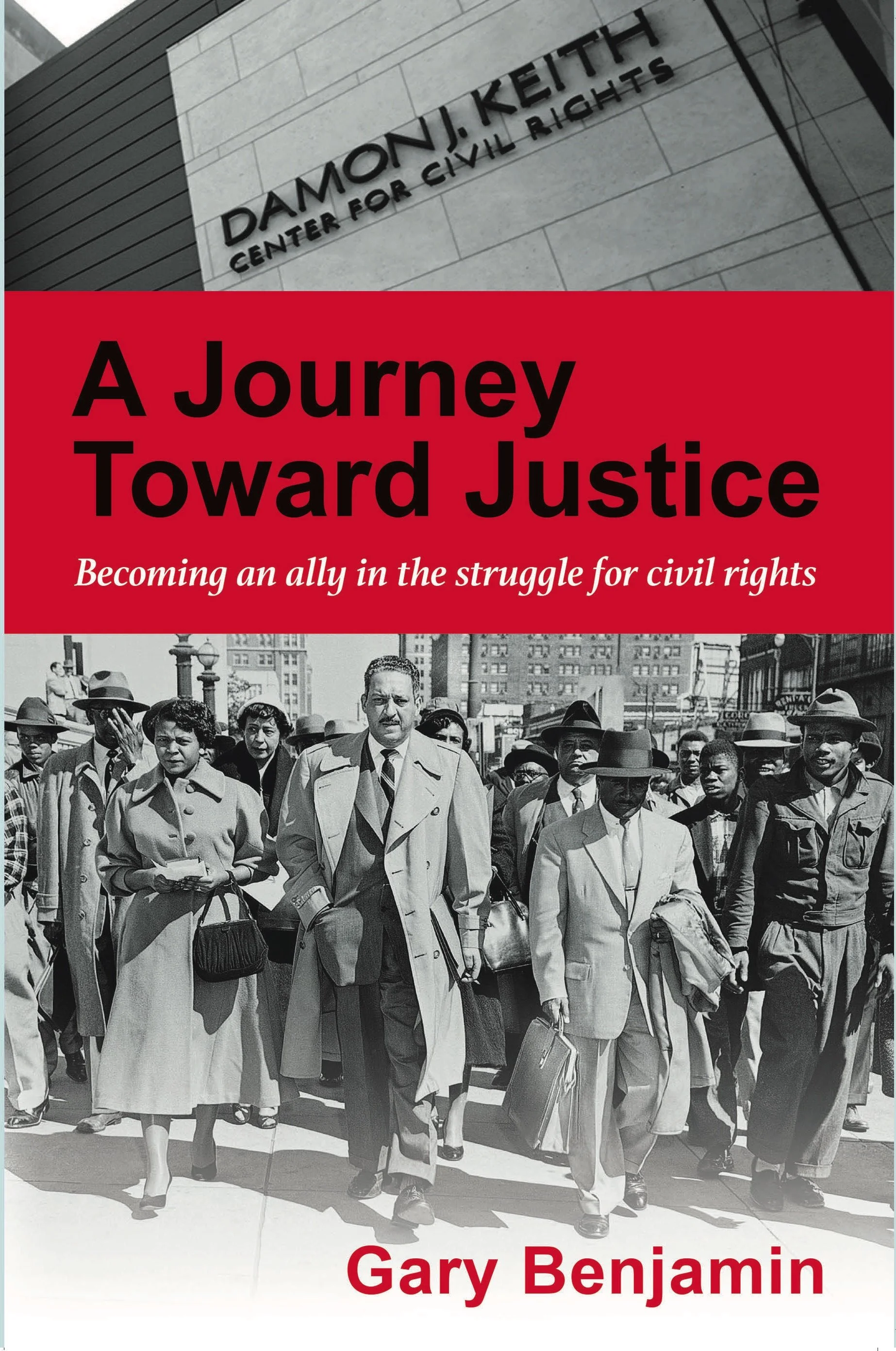
Photo cover features Autherine Lucy, left, and her legal team, NAACP attorney Thurgood Marshall, center, and Birmingham lawyer Arthur Shores, 2nd from right. Lucy was the first African American to attend the University of Alabama. Photo courtesy of Birmingham News.
A JOURNEY TOWARD JUSTICE: BECOMING AN ALLY IN THE STRUGGLE FOR CIVIL RIGHTS
BY GARY BENJAMIN
About gary benjamin

“As a White male, I have done a lot of thinking about racism in the USA and how it affected me. I ask all who read this book to think deeply about the subject. Think about your past, your upbringing, your neighborhood, your police force, your church, your employer, and your school board, city council, county commission, state government, and other institutions or organizations you frequent. Look for who is in control by race.
Or look for the positive – things that might change the racially-structured system in which we live. Look for policies that are designed to encourage inclusion of minorities in leadership position. Look for simple statements of support for people who have historically been segregated or excluded from mainstream White society. And think about why these institutions and societal structures are what they are today.”
Gary Benjamin received his Bachelor’s Degree from Ohio Wesleyan University, and his J.D. from Wayne State University. He is licensed to practice law in Michigan and Ohio.
The author tells his story in A Journey Toward Justice. Raised in a Christian family, he experienced the "Jim Crow" South from 1959 to 1963. Because of that personal history he spent a lifetime as a change agent studying and acting upon anti-racist values. This book chronicles both that experience and those efforts at social change.
The author joined in collaborations as an anti-racist ally with a number of leaders and organizers working for change in the Detroit and Cleveland areas. There are chapters on efforts to win universal health care in Michigan and Ohio, fairer lending practices for the Black community in Cleveland, a more equitable government structure for the regional government in Southeast Michigan, and a nationally recognized and successful effort to get a Haitian asylum seeker released from detention.
If you are interested in social change, this book will give you hope, education about being an ally, and ideas about issues you can work on. These issues are still relevant today. You will feel empowered after reading it.
Enjoy! Reflect! Then act!
Praise for “A Journey toward justice”

Gary Benjamin asks us this question precisely because he can imagine it, and because he has dedicated his entire life to making it a reality. Part memoir and part handbook for effective activism, A Journey Toward Justice is a powerful account of the many fronts on which people of good will must fight the scourge of white supremacy, from housing to transit, from economic justice to health care access, from electoral politics to banking.
At every stage of his life, Benjamin has witnessed, and more often than not confronted, the hydra of systemic racism in America. His account is an urgent call to action in the face of a legal system that has functionally lowered guardrails against inequity, and a story of how every step in one’s life can be taken in the direction of a greater justice. He is also a witness to the joy of justice work, speaking of deep relationships that he has formed and even of surprises along the way, including sharing the stage with Pete Seeger … not as a lawyer, but as a singer!
We must be aware, he writes, of how white supremacy “has established societal, governmental, and economic systems in the past that are still, at least to some degree, present with us.” As a lawyer, activist, and person of faith, Benjamin has worked to address those systems at every level and offers us an insider perspective on how the system continues to maintain and enforce inequity and racism.
Yet time and again he tells a story of hope. Each campaign, each legal fight, each step in the movement is a journey not only towards justice, but toward the world in which all people can grow to their potential. “Look at all the ways in which the fight can be fought,” Benjamin asks. There is no shortage of opportunities and fronts on which to engage the vital work of justice.
The need is great, but so, too, are the opportunities to take one more step in the journey. Each step, each fight, each case and each song is an invitation to create the world in which all people can live with dignity and hope. If you want to take the next step in the journey, I encourage you to start with this wonderful memoir!
— The Very Rev. Bernard J. Owens, Dean, Trinity Cathedral, Cleveland, Ohio
“Surely your colleagues or someone you know will recommend your book to be used as a text in schools of social work! I, for one, suggested to the Executive Director of Ohio NASW. Of course, law students would also benefit from your experience.
Your teamwork – Melody and Gary – I'm sure has been most rewarding and seems a core part of your fight for justice. Your connections, your work with Greater Cleveland Congregations, Legal Aid, and ACLU are all integral to your goal of justice for all. It's great that you can use your musical talent to connect with other people working for change, for justice.
I am grateful for being your ally in helping Ansly [Damus] and family.
Many thanks for sharing your legacy with me and other folks who work to be change agents for justice.
— Molly Brudnick, Member of Ansly’s Army